
We recommend wool for everyday scarf collections that need warmth and body, and cashmere for premium collections centered on a soft, lightweight feel. Traditional pashmina belongs within the cashmere family; its value also rests on evidence of origin and craftsmanship. For buyers comparing pashmina vs wool vs cashmere scarves, these distinctions help turn a product name into a clear purchase specification.
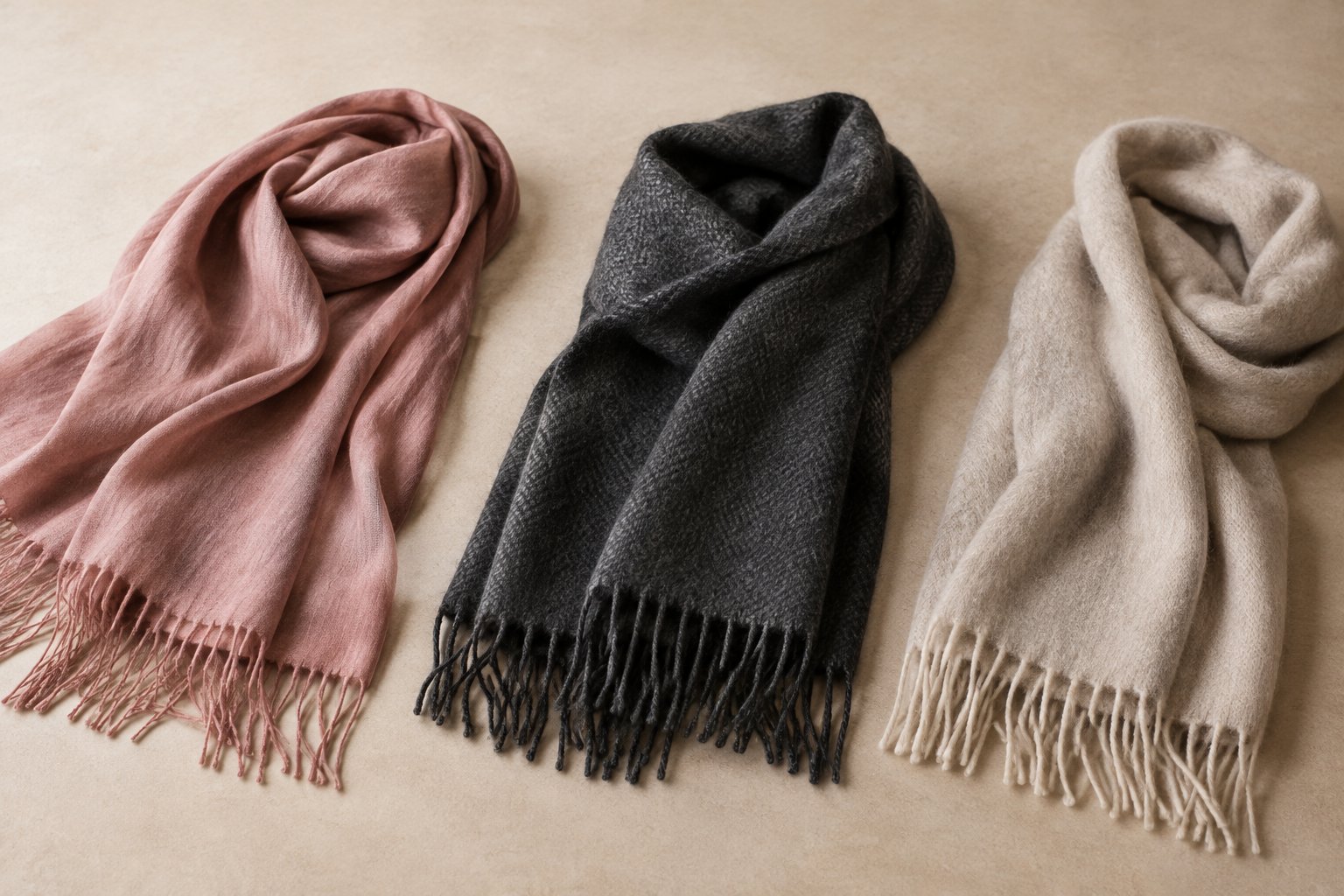
A scarf collection needs to deliver the feel your customers expect at a cost your brand supports. We recommend approving the finished fabric alongside its composition, weight and care requirements. A soft sample and a convincing product name leave important questions about bulk consistency unanswered.
How Do the Three Scarf Options Compare?
Our comparison starts with fibre identity: wool scarves use sheep’s fleece, cashmere uses the fine undercoat of cashmere goats, and traditional pashmina refers to a regional cashmere tradition. Finished warmth and comfort also depend on fabric construction.
At-a-Glance Comparison of Fibre Source, Feel, Warmth and Cost Drivers
We use the following distinctions when discussing collection positioning. The warmth descriptions assume a suitable scarf construction; they do not establish a fixed ranking between finished products.
| Criterion | Pashmina | Wool | Cashmere |
|---|---|---|---|
| Fibre identity | Traditionally regional cashmere | Sheep’s fleece | Cashmere goat undercoat |
| Expected feel | Fine, soft, fluid | Textured to very soft | Soft, light, supple |
| Warmth potential | Lightweight insulation | Lofty winter insulation | Lightweight insulation |
| Main cost drivers | Fibre, provenance, craft | Fineness, yarn, finish | Fibre quality, yield, finish |
| Evidence to request | Composition and origin records | Wool specification | Composition and fibre report |
| Collection fit | Provenance-led premium | Everyday and textured | Premium and gifting |
Cashmere vs wool is a useful starting point for budgeting. Pashmina vs cashmere needs an additional check: what origin or craft claim does the seller attach to the pashmina name?
Which Material Fits Everyday, Premium and Gift Collections?
For everyday collections, we recommend starting with lambswool or merino samples that match the intended skin contact and care expectations. Shetland wool suits a collection built around visible texture and traditional patterns.
For premium gifts, a cashmere scarf offers a clear material story when its composition is verified. Pashmina suits a provenance-led range when the supplier supports the regional claims. Packaging should protect the approved finish and carry accurate fibre information.
Is Pashmina a Separate Fibre from Cashmere?
We treat traditional pashmina as cashmere with a specific regional and craft context. A commercial product carrying that name still needs a separate, measurable fibre declaration.
How the Changthangi Goat and Ladakh Relate to Traditional Pashmina
Traditional Himalayan pashmina is closely associated with the fine undercoat of Changthangi goats raised in Ladakh. The fibre is collected and processed into yarn for fine textiles, including pashmina shawls.
We separate the animal’s origin from the place where the scarf is made. Fibre collection, spinning and finishing involve distinct stages. A claim about Ladakh fibre does not establish the location of every later production step.
Why a Pashmina Product Name Does Not Establish Fibre Content
“Pashmina” appears on products with different compositions, including cashmere blends and fabrics made from other fibres. The retail name alone leaves the percentage of each fibre unresolved.
Our recommendation is to put recognized fibre names and percentages in the contract. If the approved product contains cashmere and silk, both belong in the composition statement. You should also approve how the pashmina wording appears on packaging and product pages.
What Evidence Supports Genuine Pashmina and Origin Claims?
We recommend building the evidence around the exact claim you intend to sell. Fibre identity needs laboratory support; geographic origin needs traceable purchasing and production records.
Ask for batch-linked documents and the basis of any regional certification claim. A certificate should identify the covered product or producer. Ring tests, surface shine and softness provide no dependable proof of genuine pashmina or Ladakh origin.
Which Wool Type Suits Your Scarf Collection?
We recommend merino wool for a soft, close-to-skin brief, lambswool for a warm scarf with body, and Shetland wool for a textured collection. Each name still needs a yarn and finishing specification.
Lambswool: Softness Depends on More Than the Name
Lambswool comes from a sheep’s first shearing. Breed and fibre fineness affect its feel, while spinning and brushing shape the finished surface.
We recommend checking both the fresh sample and a sample after the proposed care process. Heavy brushing creates an immediate soft touch, but you should also inspect shedding and surface stability. The lambswool name alone gives no fixed softness level.
Merino Wool: Fineness, Elasticity and Next-to-Skin Comfort
Merino wool offers a useful balance of fine fibres and natural resilience. Its crimp helps the yarn recover after bending, which supports scarves intended for repeated wrapping.
Our merino recommendation starts with the intended wearer. For direct neck contact, ask for fibre fineness information and assess a finished sample against the skin. A broad “merino” description leaves the fibre diameter and amount of coarse fibre unspecified.
Shetland Wool: Texture, Loft and Traditional Character
Shetland wool suits scarves where a springy, textured surface forms part of the design. Checks and heathered colors work well with that character.
We recommend agreeing on the meaning of “Shetland” in the order. A breed or geographic claim requires supporting records; a style description should be presented clearly. Approve the texture as part of the product brief so later finishing does not remove its intended character.
How Can Buyers Assess Cashmere Quality?
Our cashmere assessment combines fibre measurements with finished-fabric checks. A useful report establishes what was tested, while a physical sample shows how the yarn and finish perform together.
What Do Microns and Fibre Length Tell You?
Microns measure fibre diameter. Finer fibres bend more easily, which helps explain their soft feel against skin. Fibre length affects how securely the fibres remain within the yarn.
We recommend requesting the measured values and the test method when fineness forms part of the selling claim. An average diameter gives only part of the picture. The spread of diameters and the presence of coarse hairs also affect a cashmere scarf’s comfort.
Why A, B and C Grades Are Not Universal Standards
A, B and C cashmere grades are supplier terms unless a defined grading scheme accompanies them. Different sellers attach different measurements or quality expectations to the same letter.
We recommend asking the supplier to translate its grade into measurable fields. Record the relevant fibre characteristics and yarn specification, then approve the finished hand-feel. Two “Grade A” quotations need matching technical details before you compare their prices.
What Can Laboratory Testing Verify—and What Can It Not?
Laboratory testing supports fibre identification and composition claims when the chosen method suits the material. Specialist testing also measures fibre diameter and other agreed properties.
We recommend asking the laboratory about method limits before commissioning a report. A composition result does not establish geographic origin, hand-spinning or hand-weaving. The report also represents the submitted sample, so your sampling records should connect it to the production lot.
What Determines Warmth, Softness and Scarf Weight?
We assess scarf comfort through the complete fabric: fibre, yarn structure, weave and finish. A fibre name provides a starting point, while the finished construction determines the wearing experience.
Why Fibre Name Alone Cannot Predict Warmth or Itch
Warmth comes partly from trapped air and the scarf’s coverage around the neck. A lofty wool scarf offers a different level of protection from a thin, open cashmere scarf.
For skin comfort, we look beyond average microns to coarse fibres and surface finish. Individual sensitivity also varies. Approve samples in the intended wearing position, especially when your collection promises close-to-skin softness.
How gsm Differs from Total Scarf Weight
Gsm means grams per square meter, a measure of fabric mass per area. Total scarf weight reflects both that fabric weight and the amount of fabric in the finished piece.
We recommend recording both values when they serve different quality checks:
- Gsm helps compare fabric substance across sizes.
- Finished weight helps check the complete product.
- Dimensions explain how much area the scarf covers.
- Fringe and labels need consistent treatment in the weighing method.
For a useful comparison, specify whether the measurement includes fringe and use the same conditioning procedure.
How Weave, Loft and Finishing Affect Drape and Comfort
An open construction feels airy, while a compact weave limits airflow through the cloth. Loft adds thickness through trapped air; it does not require the same increase in fabric mass.
We approve finishing alongside the weave because brushing changes both appearance and touch. Extra brushing raises more surface fibre. Compare the sample’s drape, shedding and edge stability before approving that finish for bulk production.
When Does a Silk-Wool or Cashmere Blend Make Sense?
We recommend blends when your brief calls for a particular balance of sheen, softness and fabric body. The percentage and quality of each fibre should support that purpose.
What Silk Adds to Sheen, Drape and Hand-Feel
Silk contributes a smooth surface and visible sheen to wool-based fabrics. In a suitable construction, it also gives the scarf a more fluid drape.
Our recommendation is to assess the blend under the lighting in which it will be sold or worn. A subtle sheen under diffuse light looks stronger under direct lighting. For an understated winter range, approve the amount of shine on physical cloth.
How Blend Ratios Change Performance and Cost
A higher silk or cashmere percentage changes raw-material cost, but the finished feel also depends on yarn quality and construction. Percentage alone does not predict a proportional gain in softness.
Our silk-wool scarf options include 30% silk / 70% wool. We recommend comparing candidate blends at the same dimensions and a closely matched fabric weight. That gives you a clearer view of the effect of composition.
Why Blend Descriptions Must Match Actual Percentages
Blend descriptions create a clear expectation about what the customer is buying. A cashmere blend needs its full composition stated accurately, including every other constituent fibre.
We recommend using the same approved composition across the purchase order, labels and sales copy. “Silk pashmina” needs particular care because it leaves the cashmere content unclear. Your technical specification should state the actual percentages behind the product name.
How Should Buyers Evaluate Pilling and Production Quality?
We evaluate pilling as a fabric-performance issue and inspect it alongside production consistency. Fibre authenticity and resistance to surface wear require different evidence.
Why Pilling Is Not a Simple Test of Fibre Authenticity
Pills form when loose surface fibres become tangled through friction. Cashmere, wool and merino wool all develop surface changes under suitable wear conditions.
We consider fibre length, yarn twist and finishing when reviewing that behavior. Fibre fineness alone does not predict pilling. A hand-rub demonstration also leaves friction and pressure uncontrolled, making it unsuitable as an acceptance test or proof of authenticity.
How to Agree on Pilling Tests and Acceptance Criteria
A useful pilling agreement names the method and exposure conditions before production begins. Martindale and pilling-box procedures apply different actions, so their results need to be read within the chosen method.
We recommend recording:
- The test method and applicable version.
- The number of test cycles or exposure time.
- Sample preparation and conditioning.
- The required rating and reference images.
- Whether testing occurs before or after care.
Use a qualified laboratory to select conditions suited to the scarf. Agree on how a failed result will be handled before approving bulk production.
What to Inspect in Yarn, Shade, Weave and Fringe
Our wool-scarf controls begin with yarn count and shade before weaving. Selvedge, density and pattern register are measured every 50 metres.
Finishing checks include fringe twisting and brushing. You should also compare the body and ends of the scarf for uneven texture, loose yarns or shade changes. Keep an approved physical reference available during inspection so the intended softness and finish remain visible.
What Belongs in a Scarf Purchase Specification?
We recommend a written specification that connects the fibre claim to measurable product requirements and an approved sample. The document should also identify how production will be checked.
Record Composition, gsm, Dimensions and Agreed Tolerances
Start with fibre percentages, fabric weight and finished dimensions. Record whether fringe sits inside or outside the stated length.
Our preferred specification also defines:
- Yarn count and weave.
- Brushed or flat finish.
- Fringe or hem construction.
- Measurement and conditioning methods.
- Agreed tolerances for each controlled feature.
- Required testing and batch identification.
Set tolerances with the production team before ordering. A single tolerance applied to every measurement leaves avoidable gaps, especially where fringe and brushed surfaces affect the reading.
Approve Physical Samples, Colour References and Finishing
A physical sample gives both parties a shared reference for feel and construction. Color numbers provide a useful starting target, but the chosen yarn and surface finish affect the visible result.
Our first product samples are generally finished in 10–15 working days and couriered with specifications for approval. For wool projects, we confirm fibre and yarn count before artwork development, followed by yarn dyeing, weaving and sample approval.
Verify Fibre Labels and Care Requirements for the Destination Market
For a US-bound order, we recommend a label review against current federal requirements before artwork approval. Your importer or compliance adviser should verify fibre terminology and percentages, country of origin, responsible-party identification and the applicable care-label obligations.
Care symbols and wording also need to match the validated product instructions. We support export documentation for US customs requirements, while your label approval process should cover the claims printed on the scarf, hangtag and packaging.
Compare Quotes Using Matched Specifications and Order Quantities
Matched quotations make price differences easier to explain. Align composition, size, fabric weight and finish before comparing the unit price, then check packaging and shipping terms separately.
Our custom wool-scarf service lists these minimums and production lead times:
- Lambswool, 180 cm: 300 pieces per style; 35–45 days.
- Merino, 200 cm: 300 pieces per style; 35–45 days.
- Silk-wool blend: 300 pieces per style; 35–45 days.
- Cashmere blend: 500 pieces per style; 40–50 days.
Confirm the production start point and shipping allowance in your quotation. For winter collections, we recommend early capacity planning because yarn dyeing, weaving and fringing compete for mill slots from June onward.
What Care Requirements Affect Everyday Use?
We recommend choosing care requirements during product development so they fit the collection’s intended use. A daily scarf needs instructions that customers will follow and that the finished product has been checked to support.
Follow Validated Care Instructions Rather Than Fibre Assumptions
A cashmere scarf’s care needs also reflect its dyes and finishing treatments. The same applies to pashmina shawls and merino wool scarves, including products carrying washable claims.
We recommend validating the proposed process on a finished sample. Review dimensional change, shade and surface appearance after care. Hand washing is appropriate only when the product instructions permit it; embellished or specially finished scarves need their own assessment.
Reduce Friction, Dry Flat and Store Against Moth Damage
Our care recommendation starts with limiting repeated rubbing against rough coat collars, fasteners and bag straps. For surface pills, use a suitable fabric comb gently and avoid pulling loose fibres by hand.
After permitted wet cleaning, support the scarf and dry it flat away from direct heat. Store it clean and fully dry in a sealed container or protective storage bag. Inspect stored animal-fibre accessories for moth activity, especially during long periods between wears.
Choose the Fibre Specification, Not Just the Name
We recommend wool for everyday warmth and textured collections, cashmere for a soft premium brief, and pashmina positioning when its composition and provenance claims have clear support. A finished sample should confirm the fabric weight, feel and care requirements behind that choice.
For a technical recommendation from Guridio, send your desired fibre composition, finished size, quantity and target feel through our enquiry form. Include a reference sample or fabric image so we can recommend a suitable construction and finishing approach before pricing.