
For a businesswear collection, we recommend 16–19 momme silk twill as a starting silk tie fabric because its diagonal texture gives a restrained sheen and supports a well-defined knot when paired with suitable interlining. At Guridio, we confirm weave, weight and fold construction before artwork goes to the mill, helping you develop silk ties that meet your intended look and target price.
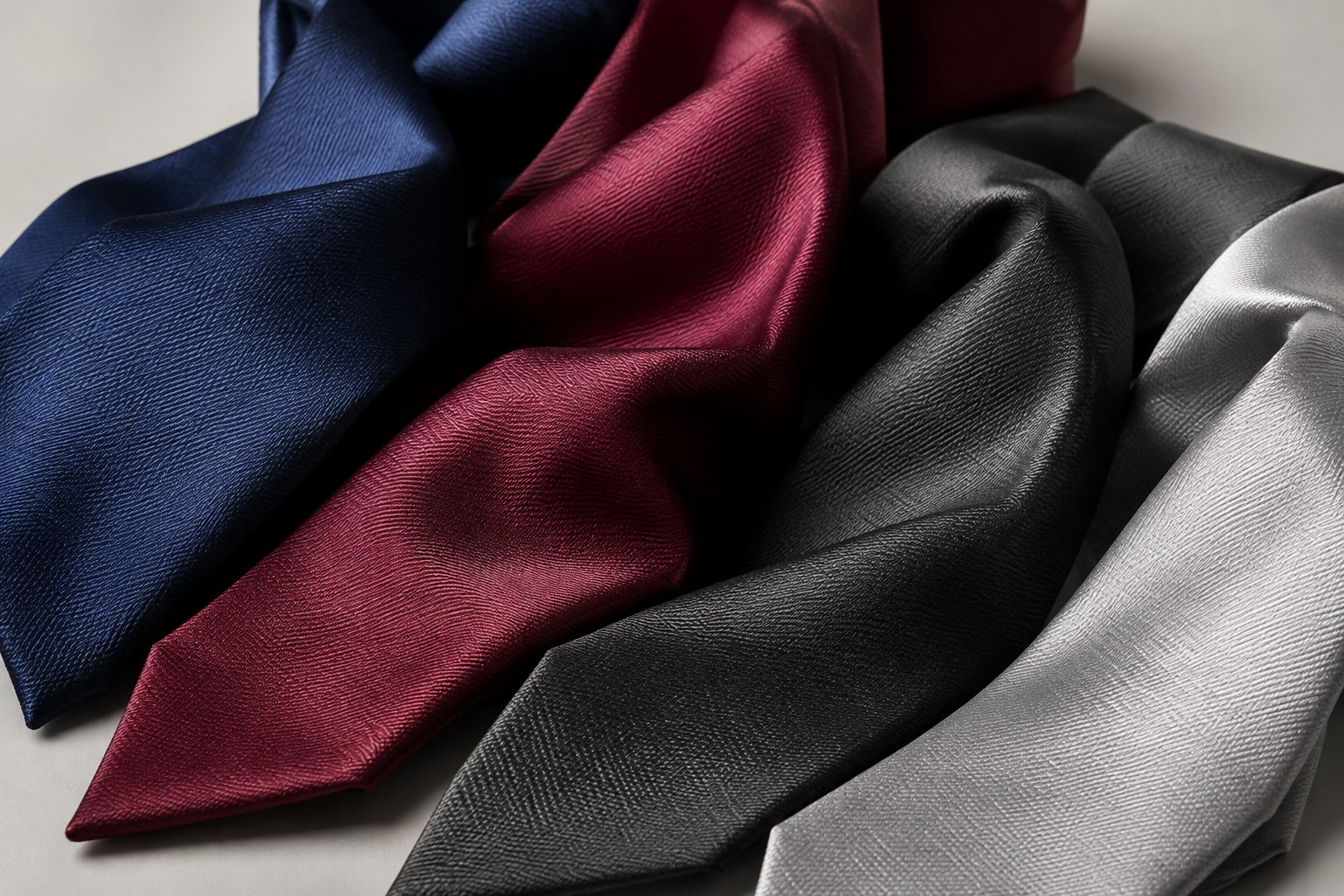
A fabric swatch gives you an initial impression; a sewn tie reveals how that choice performs. Silk fabrics with the same composition and weight still differ in surface friction, flexibility and response to finishing. Those differences become visible when the tie is knotted, tightened and allowed to hang.
For sourcing, we recommend treating the cloth and finished accessory as connected specifications. A heavier shell needs a carefully balanced internal structure, while an intricate pattern needs a production method that preserves its detail at tie scale.
Which Weave Gives Your Collection the Right Look?
We recommend twill for understated business collections, satin for a pronounced sheen, and plain weave for a quieter surface. Jacquard patterning adds another design dimension through controlled changes in the woven structure.
Plain, Twill and Satin: Comparing Sheen, Drape, Abrasion and Knot Behaviour
Plain weave interlaces warp and weft in an alternating sequence. Twill creates diagonal ribs, while satin uses longer surface floats that reflect light across a smoother face.
Our comparison below assumes similar fiber quality and weight. Yarn selection and finishing still influence the finished result.
| Characteristic | Plain silk | Silk twill | Silk satin | Jacquard-patterned silk |
|---|---|---|---|---|
| Sheen | Subtle | Restrained, directional | Strong, smooth reflection | Varies across the pattern |
| Drape | Crisp to supple | Balanced | Fluid | Structure-dependent |
| Abrasion and snag exposure | Short exposed floats | Good everyday starting point | Exposed floats need care | Depends on float length |
| Knot behavior | Compact with suitable lining | Defined with moderate grip | Smooth; check slippage | Check local thickness |
We use this comparison to narrow material choices before sampling. A dense, heavily finished plain weave and a soft twill will behave differently even when their momme figures match.
How Jacquard Patterning Works with Basic Weave Structures
Jacquard describes a method of controlling individual warp yarns to create woven designs. A jacquard fabric can combine twill, satin and other structures within the same repeat.
For example, we can develop a restrained background with a more reflective motif by changing the interlacing. The resulting contrast comes from structure as well as yarn color, so a single-color jacquard still has visible pattern depth.
This distinction keeps procurement language precise: “silk jacquard” needs additional detail about weight, texture and the intended pattern effect.
Matching Fabric Character to Business Attire and Occasionwear
For conventional business attire, we favor fine textures and controlled reflection. A subtle twill or small-scale jacquard complements a tailored suit without dominating the shirt front.
For wedding collections, satin supplies a brighter finish, while textured silk gives a softer visual effect. We recommend reviewing pale colors against the intended shirt fabric because opacity and reflected light affect their appearance.
Evening dress codes need their own product decisions. A long satin tie belongs to a different styling brief from the bow tie required for conventional black-tie attire.
How Does Momme Affect a Finished Tie?
Momme describes silk fabric weight, and increasing it changes the amount of cloth contributing to the tie’s body. We assess that weight alongside the shell structure and internal components.
Choosing Between 16, 19 and Heavier Silk Weights
We use 16 momme as a useful starting point for lighter conventional ties and 19 momme when the brief calls for more substance. With otherwise comparable fabric, the heavier option contributes additional fullness and opacity.
A 22-momme or heavier silk deserves a sewn development sample before approval. It adds material around the knot and along folded edges, which affects narrow ties especially.
Our recommendation is to compare adjacent weights in the same weave. Comparing a lightweight satin with a dense jacquard makes it difficult to isolate the effect of momme.
Balancing Fabric Weight, Interlining and Fold Construction
We develop 3-fold, 5-fold and 7-fold ties, and each construction distributes cloth differently. Interlining adds support and recovery in lined constructions; additional shell folds contribute their own thickness.
Increasing shell weight while retaining a substantial interlining produces a fuller result. If the sample feels rigid or the knot becomes oversized, we review the lining specification and fold arrangement.
For a multi-fold design, we establish the exact construction before selecting cloth. Fold terminology alone leaves too much uncertainty about internal support and total bulk.
Testing Bulk and Drape with a Four in Hand Knot
We knot samples and first-off bulk ties to assess knot formation and drape. A four in hand knot provides a useful reference because its compact shape makes excess thickness easy to identify.
For your approval review, we recommend checking:
- Whether the knot tightens smoothly.
- Whether the blade forms a controlled dimple.
- Whether the tie hangs straight below the knot.
- Whether the narrow blade passes comfortably through the keeper.
- Whether the knot zone relaxes after untying.
Keep the collar and knot style consistent when comparing samples. That gives you a more meaningful basis for approving the construction.
What Does Finishing Change Beyond the Weave?
Finishing changes the touch, reflection and body of silk fabrics after weaving or printing. We specify the intended finished handle so bulk approval refers to cloth in its production-ready state.
Softness, Lustre and Body After Finishing
Scouring, washing and controlled pressing influence how silk feels and reflects light. Softening treatments also affect surface friction and flexibility.
We ask buyers to describe the desired result through a physical reference: crisp, fluid, softly structured or firm. “Luxury finish” leaves room for different interpretations across suppliers.
The approval sample should represent the complete processing sequence. An unfinished woven sample gives useful structural information, but the final handle requires review after the agreed finishing stages.
Assessing Snagging, Crease Recovery and Surface Wear
We review surface exposure alongside the intended frequency of use. Long floats and open textures need particular attention where the knot experiences repeated compression and rubbing.
For development, we recommend examining the cloth under directional light, then reviewing a sewn sample after knotting. Look for pulled yarns, flattened texture, persistent creases and changes in surface sheen.
If abrasion resistance or crease recovery is a contractual requirement, define the test method and acceptance level before ordering. A visual sample review and a laboratory performance test serve different approval purposes.
Should Your Pattern Be Woven or Printed?
We recommend jacquard for structural texture and printing for artwork that needs fine detail or smooth tonal transitions. Both methods support sophisticated silk ties, with different setup requirements.
Jacquard Texture vs. Printed Detail and Gradients
Jacquard builds the design into the fabric through yarn selection and interlacing. It suits motifs whose character benefits from tactile depth, including geometric repeats and restrained logos.
Printing applies a design to an existing fabric, including twill or satin. Digital printing is particularly useful for gradients and artwork with many tonal variations.
We review small lettering and fine outlines at finished size before recommending a method. Details that read clearly on a screen need enough physical space to survive weaving or printing.
How Repeat Size, Yarn Colours and Print Method Affect Sourcing
A woven repeat must work within the selected loom setup and yarn arrangement. Changing yarn colors or adding structural complexity affects development work and production planning.
For printed fabric, screen preparation creates setup costs for the selected design and colors. Digital printing avoids individual screens, making it useful for shorter custom runs.
For our fabric-printing service, we generally recommend digital printing below 300 metres and screen printing above that volume. The final recommendation also accounts for artwork and the required fabric. Our custom fabric printing service includes file preparation and a method recommendation.
Approving a Woven Sample or Printed Strike-Off
We supply a real woven sample or printed strike-off so you can judge the design on cloth. Screen approval establishes artwork direction; physical approval establishes its textile appearance.
For jacquard, review motif clarity and reverse-side floats. For printing, inspect fine lines, solid coverage and transitions between colors.
Bulk printing requires an approved strike-off on the same fabric and printer. We also recommend retaining an identified approval reference with the signed specification so later inspections use the same benchmark.
Where Do Grenadine and Knitted Styles Fit?
We position grenadine as a textured option for tailored collections and knitted silk as a more relaxed neckwear format. Their different structures require separate sourcing specifications.
Grenadine: Open Woven Texture Rather Than Knit
Grenadine is an open, gauze-like woven fabric with a visible mesh structure. Its texture gives solid-color grenadine ties depth without requiring a printed motif.
We source specialist grenadine cloth and coordinate the subsequent tie construction. Garza grossa provides a more pronounced texture, while finer variants create a quieter surface.
During selection, we review mesh scale and consistency alongside the proposed interlining. The lining’s color also deserves attention because the open structure exposes it through the cloth.
Knitted Silk: Stretch, Recovery and a More Relaxed Look
Knitted ties derive their stretch from interlocking yarn loops. Their textured appearance and frequent square-ended construction suit relaxed tailoring and business-casual collections.
We source knitted products through specialist supply channels. Specifications need to address finished dimensions, knitting density and recovery after extension.
We recommend confirming the measurement condition for length. A relaxed knitted tie and one measured under tension produce different figures, which creates avoidable disputes at inspection.
What to Confirm When Sourcing Specialist Fabrics and Products
For specialist orders, we establish whether you need cloth, a partially finished component or a completed tie. Each purchasing format assigns different responsibilities for construction and inspection.
Your brief should include a physical reference, finished dimensions and the intended surface character. For grenadine, identify the mesh specification; for knitted products, define density and end treatment.
We also recommend documenting the permitted dimensional variation after handling. Specialist textures need approval references that capture their physical behavior as well as appearance.
When Is a Polyester Counterpart Worth Considering?
We recommend evaluating polyester for frequent-use uniforms and price-sensitive volume programs. Silk remains a strong choice when natural luster and material positioning support the collection’s selling price.
Comparing Equivalent Weaves Rather Than Fibre Labels Alone
A useful material comparison starts with equivalent constructions. We compare twill with twill or satin with satin, while keeping finished width and internal support aligned.
Polyester supports both printed and jacquard designs. Its appearance changes substantially with yarn fineness and finishing, so the fiber name alone gives an incomplete picture.
For your review, we recommend comparing actual samples for reflection, knot grip and recovery after handling. Neither fiber label guarantees suitable colorfastness or a particular care method.
Choosing Materials for Uniforms, Gifts and Premium Collections
For uniforms, we prioritize repeated-use performance and replacement availability. Polyester deserves consideration where cost control and regular replenishment lead the brief.
For gifts, we assess the accessory together with its packaging and intended price position. Silk supplies a recognizable material story, while polyester supports more economical coordinated programs.
For premium collections, we recommend specifying the silk content explicitly and matching it with suitable construction. A silk shell paired with poorly balanced interlining still produces an unsatisfactory tie.
What Drives Fabric and Finished-Tie Costs?
Our fabric and finished-tie quotations reflect material consumption, production setup and the labor required by the approved construction. Comparing prices requires matching the underlying specifications.
Fibre, Weight, Weave Complexity and Finishing
Silk content and momme influence the material cost of a defined fabric construction. Yarn quality, weave density and specialist finishing add further differences between silk fabrics carrying similar descriptions.
Jacquard complexity also changes development and production requirements. A large motif with several structural effects needs a different assessment from a simple repeat.
We separate the fabric decision from optional finishing upgrades during quotation. That helps you identify which changes improve the product within your target price.
Setup Costs, Colour Count, Cutting Yield and Order Quantity
Custom jacquard carries card and loom-setup costs. Screen printing carries screen costs, while additional colors increase preparation requirements for the relevant process.
Cutting yield affects the amount of cloth allocated to each tie. Bias layout, usable width, motif placement and fold construction all influence consumption.
We confirm yield against the actual pattern layout. A fixed “ties per yard” assumption becomes unreliable when tie dimensions or repeat placement change.
Why Stock Fabric and Custom Development Have Different Minimums
Stock fabric uses an existing cloth construction and available color or pattern. Custom development adds fabric preparation and production commitments before tie assembly begins.
Our stock fabric with own label program starts at 300 pieces per style. Custom jacquard starts at 500 pieces per design, while printed silk starts at 300 pieces per design.
Those are finished-product minimums. We quote fabric-only development separately because its ordering unit and setup requirements differ.
What Should Your Procurement Specification Include?
We recommend a written specification that connects measurable fabric requirements with the intended tie construction. It should give production and inspection teams the same approval criteria.
Specify Fibre Content, Weave, Momme and Usable Width
Start with exact composition, such as “100% silk,” followed by the weave and target momme. State agreed tolerances so weight approval has a defined basis.
Usable width needs its own field, separate from total roll width. Selvedges and excluded edge areas affect cutting yield.
For reference, our custom silk jacquard options include 16 momme / 114 cm and 19 momme / 114 cm. Your purchase specification should clarify the usable cutting width within the selected construction.
Define Colour Targets, Pattern Method, Repeat and Finish
We recommend providing a color reference number together with a physical target whenever possible. Include the reference system because numbers from different color libraries are not interchangeable.
Specify whether the pattern is jacquard woven, digitally printed or screen printed. Add repeat dimensions and placement requirements for prominent motifs.
The finish description should refer to an approved swatch. Record expectations for handle and sheen, plus any required fastness testing and acceptance levels.
Buying by the Metre or Yard vs. Ordering Finished Accessories
Fabric-only procurement gives your cutting and sewing team responsibility for conversion into ties. Finished-accessory procurement includes the agreed construction, labels and packing.
We quote fabric programs by the metre. If your purchasing system uses yards, request a clearly identified conversion: one yard equals 0.9144 metre.
Compare quotations at the same usable width and ordering unit. For finished accessories, include dimensions and construction details so the quote covers the product you intend to sell.
Separate Fabric Minimums from Finished-Tie Minimums
We keep fabric quantities and finished-piece quantities distinct in the quotation. They represent different production commitments and should appear as separate purchase-order fields.
Our silk jacquard fabric minimum is 300 metres per design for the listed 16- and 19-momme options. Digital print on silk starts at 50 metres per design; screen print on silk starts at 300 metres per design.
For finished ties, use the applicable product minimum and confirm colorway allocation. Our custom jacquard fabric service provides a weave recommendation, card cost and per-metre price.
How Does Guridio Validate Your Fabric Choice?
We validate a fabric choice through technical review, physical approval and documented production checks. The same coordinated team follows your project from the initial brief through final inspection.
From Artwork and Target Price to a Technical Recommendation
We begin with your artwork or reference sample, quantities and target price. Our team confirms the proposed weave, momme and fold construction before production setup.
Artwork development includes repeat adjustment and color separation where required. We also assess whether a woven or printed approach fits the design at the intended scale.
Through our custom tie manufacturing service, you receive a written construction recommendation before pricing. This establishes a defined starting point for sampling.
Approve Real Cloth and a Sewn Sample Before Bulk Production
First product samples are generally finished in 10–15 working days and couriered with specifications for approval. The development kit includes the relevant fabric reference and a made-up tie in the selected construction.
We also supply a packaging mock-up as appropriate to the order. That allows you to assess product fit before bulk packing materials are committed.
Your approval should identify the accepted sample and any revisions. A signed specification sheet or approved strike-off reference then supports the bulk-production instructions.
Check Fabric Quality, Knot Formation and Drape Against Approved References
We check fabric rolls using the 4-point standard for relevant shade and weave defects before cutting. In-line tie checks cover tension, tip symmetry and bar tacks every 200 pieces.
Samples and first-off bulk ties are knotted and hung to assess knot formation and drape. Pre-shipment checks use applicable AQL sampling, supported by photographs and signed inspection records.
These records give you a documented comparison with the approved references before dispatch. Any specified laboratory performance requirements should also appear in the agreed inspection plan.
Choose the Cloth and Construction Together
We recommend approving silk ties as complete products, with the fabric and internal structure selected together. Weave establishes surface character; momme contributes weight; finishing adjusts the final handle.
Before bulk approval, review real cloth and a sewn sample against your written specification. Confirm the purchasing unit and applicable minimum so fabric quantities and finished-piece commitments remain clear.
For a fabric recommendation, send us your fabric reference, intended tie construction and target price through the Guridio enquiry form. Include quantities and artwork if available so our team can assess the appropriate development route.
Frequently Asked Questions
We recommend using the answers below to clarify material descriptions before requesting samples. Exact composition and construction should also appear on your quotation.
What type of silk is best for ties?
We recommend 16–19 momme silk twill as a practical starting point for conventional business ties because it combines restrained sheen with a defined texture. For brighter occasionwear or tactile patterns, we recommend reviewing satin or jacquard samples in the intended construction.
Are silk ties always made of real silk?
We treat “silk tie” as a fiber-content claim, while descriptions such as “silky” or “silk-feel” describe appearance or touch. For purchasing, we recommend stating the exact silk percentage in the specification and checking that the product labeling matches.
What is the difference between a satin tie and a silk tie?
We use “satin” to describe a weave and “silk” to describe a fiber. A satin tie might contain silk or polyester, so we recommend requesting both the weave description and exact composition.
Can I buy silk tie fabric by the yard?
We support fabric-only sourcing and quote our fabric programs by the metre; other sellers offer yard-based quantities. For your order, we recommend confirming the unit, usable width and minimum cut length before comparing prices.
Can a silk tie fabric be both twill and jacquard?
Yes, we can develop jacquard-patterned silk that incorporates twill structures. We recommend specifying both terms when you want a woven motif together with a defined diagonal texture.