
For everyday men’s wool and cashmere scarves, we recommend merino for a soft, springy feel under a winter coat, lambswool for a fuller texture, and cashmere for buyers who prioritize softness with low bulk. For a brand collection, the strongest starting point is a finished sample that shows how the chosen fabric feels against the neck and fits beneath the intended outerwear.
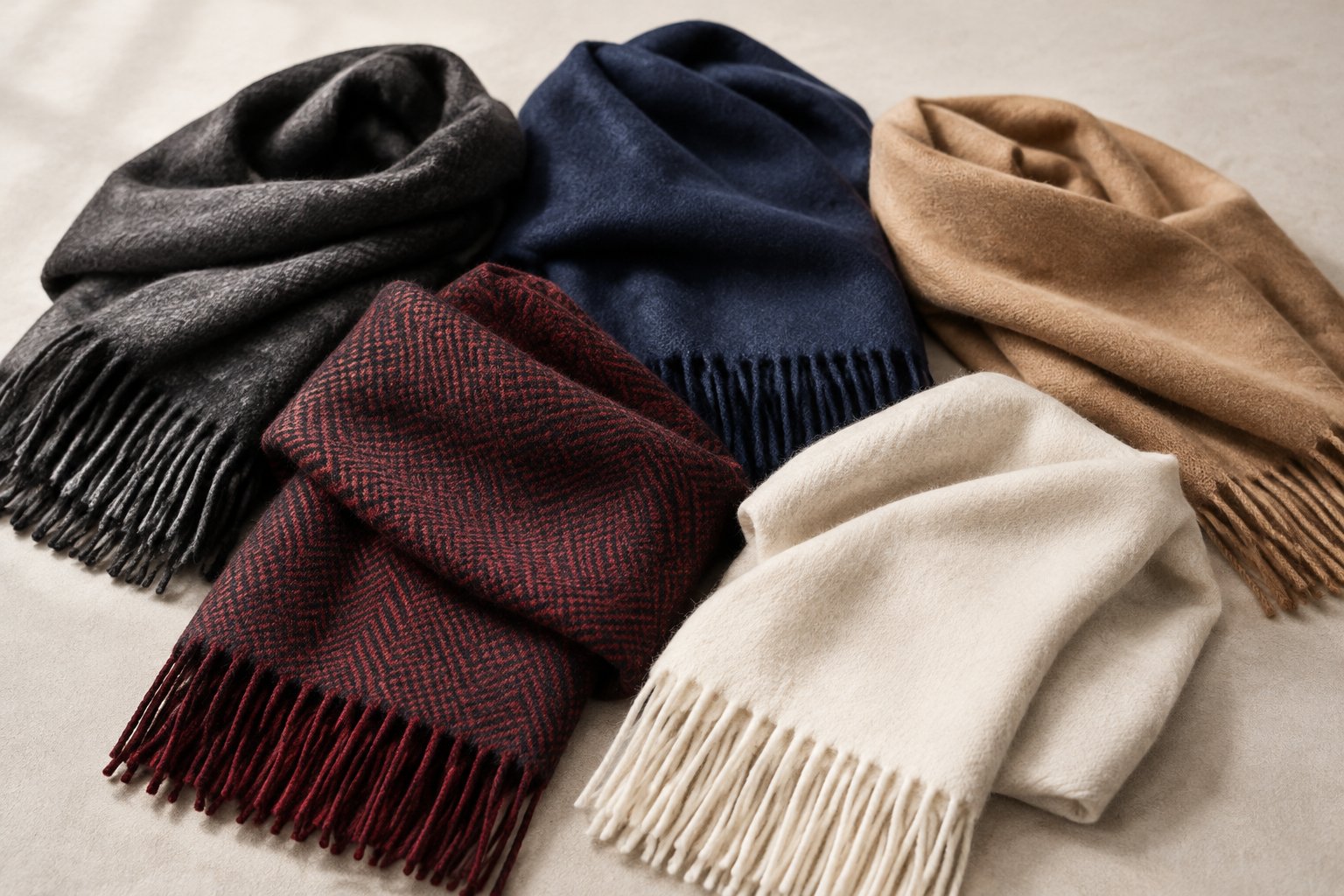
We recommend comparing cashmere scarves with wool and silk-wool options before settling the specification. Fiber content shapes the result, but yarn quality and finishing also change the surface, drape, and warmth. A very soft sample still needs clear measurements and a repeatable production standard.
Which Fibre Offers the Right Feel and Finish?
We favor merino for everyday tailoring, lambswool for textured winter styles, and cashmere for a soft finish close to the skin. Silk-wool blends add another choice when you want smoother drape or visible sheen.
Lambswool, Merino and Cashmere Compared
We treat these fiber names as a starting point for sample selection. Lambswool describes wool from a sheep’s first shearing, while merino identifies a sheep breed. Cashmere comes from the fine undercoat of cashmere goats.
| Buying consideration | Lambswool | Merino | Cashmere |
|---|---|---|---|
| Handle to look for | Full and springy | Fine and flexible | Soft and light |
| Surface character | Textured or brushed | Smooth or softly raised | Fine, soft nap |
| Styling direction | Tweed and casual coats | Suits and daily outerwear | Dress coats and gifts |
| Main sample check | Comfort at the neck | Recovery after folding | Surface stability |
| Care priority | Protect against felting | Follow the specified wash route | Limit friction and stretching |
We recommend feeling each finished sample at the neck, where sensitivity differs from the palm. Softness alone does not establish composition or durability. For a cashmere claim, you should also agree on appropriate fiber-content evidence.
What Does Silk Add to a Wool Blend?
We recommend silk-wool when you want wool’s winter character with a smoother fall. Silk adds luster, while the blend ratio and weave control how visible that shine becomes.
Our development options include 30% silk / 70% wool, with jacquard or plain weaves. A brushed finish softens the pattern edges; a flatter finish keeps the design clearer.
For tailoring, we suggest checking the scarf beside the actual coat cloth. A gentle sheen works well against a matte overcoat, and it carries no automatic judgment about quality.
When Is a Cotton Scarf a Useful Alternative?
We suggest a cotton scarf for mild weather, indoor wear, or a collection aimed at lighter layering. Cotton gives a different surface feel and suits buyers who prefer a plant-based fiber against the neck.
For cold-weather development, we would keep cotton as a separate sample comparison. Its warmth and bulk need their own assessment.
You should also confirm the finished care instructions. The word “cotton” alone does not establish that a scarf’s dyes, trims, and construction suit machine washing.
What Dimensions Work for Different Fits and Knots?
We recommend choosing dimensions around the intended tying method and coat fit. Length controls the available wraps, while width affects coverage and the size of the knot.
Typical Length and Width Options Without Rigid Gender Rules
We use rectangular formats as a practical starting point for tailored winter scarves. Common development references include lengths around 70–72 inches and widths of 8–12 inches. Our wool-scarf programs include 180 cm lambswool and 200 cm merino options.
These dimensions suit people across gender categories. Your customer’s height, preferred coverage, and outerwear provide a better fit brief than a gender label alone.
We recommend stating whether the finished length includes fringe. Body length and fringe length should have separate measurement points so both parties inspect the same feature.
Matching Length to a Drape, Once-Around Wrap or Parisian Knot
We suggest checking your preferred length in each tying method you plan to show in product photography or sell through styling advice.
- Drape: Hang the scarf around the neck with both ends forward. Check where the ends fall with the coat open.
- Once-around wrap: Leave one end longer, then pass it around the neck. Check that enough fabric remains for both ends to sit securely.
- Parisian knot: Fold the scarf in half, place it around the neck, and draw the loose ends through the folded loop. Check the remaining end length.
For a Parisian knot, we pay particular attention to fabric thickness. Folding doubles the layers before the ends pass through the loop, so a heavy scarf needs a careful fit review.
Checking Bulk and Coverage With the Intended Coat
We recommend approving fit with the coat buttoned. An open-coat fitting gives little information about pressure beneath a close collar.
You should check whether the scarf pushes the lapels outward, crowds the chin, or leaves a gap at the back of the neck. Wider cashmere scarves offer extra coverage, but the folded width still needs to sit comfortably inside the collar.
We also suggest testing normal movement. Turn the head and raise the arms to see whether the scarf stays in place or pulls tight.
How Should You Specify Weight and Compare Samples?
We recommend specifying both fabric weight in gsm and the finished scarf’s weight. These describe different features: gsm measures mass per area, while finished weight covers the complete item.
Considering 200, 300 and 400 gsm as Specification Options
We treat 200, 300, and 400 gsm as options to discuss during development. They are neither universal scarf grades nor confirmed Guridio inventory.
A 200 gsm brief provides a starting point for lower-bulk layering. At 300 gsm, you are asking for more mass across the same area. A 400 gsm option needs particular attention to knot size and comfort beneath tailoring.
We recommend requesting the supplier’s proposed construction for your preferred weight. Cashmere and wool fabrics with the same gsm still differ in thickness and drape. Agree on the target tolerance and measurement condition before approval.
How Weave, Brushing and Density Affect Handle
We assess weight alongside weave and finish because each changes the result. A dense, flat fabric gives a different feel from a more open fabric with a raised surface.
Brushing lifts fibers to create a softer, fuller surface. It also changes pattern clarity, so a sharply drawn check needs review after the final finishing stage.
For our wool-scarf development, we confirm fiber and yarn count before artwork development. We then coordinate yarn dyeing and sampling, with brushed or flat finishes selected as part of the specification.
Comparing Softness, Drape, Pilling and Finished Weight
We recommend comparing samples of the same finished size under similar conditions. Packaging should be removed before weighing, and each sample should be identified by its construction and revision.
Your comparison should record:
- Neck comfort, including any prickly sensation.
- Drape over a coat lapel and through the intended knot.
- Surface shedding, loose fibers, and existing pills.
- Finished weight, with the weighing method stated.
- Edge stability and recovery after gentle handling.
We use touch to assess handle, while laboratory testing supports performance claims. For a bulk order, agree on a pilling test method and acceptance level suited to the product. A soft hand sample provides limited evidence about wear over time.
Which Colours and Patterns Work With Tailoring?
We recommend a clear difference in color depth or pattern scale between scarf and outerwear. This helps the scarf remain visible without making the coat front look crowded.
Coordinating Scarves With Overcoats and Suits
We suggest charcoal, navy, camel, and muted burgundy as useful starting colors for a tailored collection. Each needs checking against your intended coat palette.
With a navy overcoat, a gray or camel scarf creates an easy distinction. Charcoal outerwear gives room for burgundy, while a camel coat works well with deep blue.
For cashmere scarves, we recommend reviewing the finished surface in daylight and indoor lighting. Brushing changes how the fabric catches light, so a yarn card does not fully represent the final appearance.
Choosing Plain Colours, Stripes and Reversible Designs
We favor plain colors when the coat already has a strong pattern. Stripes add direction to a plain outfit, and reversible designs offer two visible color treatments within one product.
For stripes, you should approve the repeat across the finished width and check how it appears when folded. A stripe hidden inside the knot contributes little to the worn design.
We recommend reviewing both faces of a reversible sample. Confirm the appearance of the edges and fringe, along with the label position, so either intended face presents cleanly.
Checking Tartan, Houndstooth and Windowpane Alignment
We recommend defining pattern placement in the specification, especially for large checks. A centered windowpane and an offset windowpane produce different finished looks.
Tartan needs an approved repeat and color sequence. Houndstooth needs enough clarity to remain recognizable after finishing. For windowpane designs, you should inspect line direction and spacing along the body.
A scarf body may have no joined seam to match. In that case, our checks focus on straight pattern lines, balanced cutting, and consistent end placement. Any joined panels need a separate alignment requirement.
What Should Buyers Confirm Before Bulk Production?
We recommend releasing bulk production only after the physical sample and written specification agree. Your approval should identify the accepted product revision and resolve any remaining changes.
Approving Composition, Shade, Dimensions and Finishing
We ask buyers to approve the finished accessory alongside the relevant yarn or material references. A cashmere scarf specification should state the exact fiber percentages and the evidence required to support them.
Your approval record should also define:
- The physical shade reference and accepted color variation.
- Finished body dimensions, fringe length, and tolerances.
- Target weight and measurement method.
- Brushed or flat finish.
- Edge treatment and label placement.
Our final inspections compare goods with approved samples and specifications. We provide photographs and signed inspection records before dispatch so you can review the production result.
Understanding Minimum Orders and Seasonal Lead Times
We publish different minimums for different constructions because fiber and finishing affect production planning.
| Our scarf option | Minimum order | Published production lead time |
|---|---|---|
| Lambswool, 180 cm | 300 pieces per style | 35–45 days |
| Merino, 200 cm | 300 pieces per style | 35–45 days |
| Silk-wool blend | 300 pieces per style | 35–45 days |
| Cashmere blend | 500 pieces per style | 40–50 days |
Our first product samples are generally finished in 10–15 working days and couriered with specifications for approval. You should confirm the basis of the quoted bulk schedule, including approval time and shipping.
We recommend early capacity planning for winter collections. Yarn dyeing, weaving, and fringing compete for mill slots from June onward. Our custom wool-scarf service coordinates development through production and export preparation.
Specifying Fibre and Origin Labels, Gift Boxes and Transit Packing
We recommend approving label wording with your US importer or compliance adviser before printing. Wool-product labeling requires accurate fiber information, country of origin, and responsible business identification, subject to applicable rules.
A cashmere-blend label needs its actual composition. “Cashmere touch” describes a feel and provides no fiber percentage. You should also distinguish the fiber’s origin from the finished product’s country of origin.
For packaging, we develop boxes around the scarf’s folded dimensions. Our rigid gift boxes have a minimum order of 500 pieces per style and a production lead time of 20–30 days.
We suggest approving the scarf inside its packaging. Check for compression marks and label visibility, then confirm carton quantities and moisture protection for transit.
How Can Care Preserve Shape and Softness?
We recommend following the finished product’s care label and supporting wet scarves during drying. Gentle handling protects the surface and reduces changes in shape.
Following the Care Label for Washing and Drying
We give the care label priority because cashmere scarves differ in their dyes, finishes, and construction. Where hand washing is permitted, use cool water and a detergent intended for wool or cashmere.
You should handle the scarf gently, rinse without scrubbing, and press out water without twisting. Support the full item as you lift it, then reshape it on a clean towel to dry flat.
We advise keeping wet scarves away from direct heat. If the label calls for professional cleaning, choose a cleaner familiar with fine wool accessories and point out any stains.
Managing Pilling and Storing Scarves Between Seasons
We regard pilling as a feature to monitor during wear. Friction lifts loose fibers that gather into small balls, especially where the scarf rubs against a collar or beard.
You should remove pills gently with a suitable cashmere comb or fabric-care tool, following its instructions. Pulling pills by hand risks drawing out attached fibers.
For seasonal storage, we recommend cleaning the scarf as directed and letting it dry fully. Fold it loosely into breathable storage with suitable moth protection, then check periodically for dampness or insect activity. Untie knots before putting the scarf away.
Choose by Feel, Fit and an Approved Sample
We recommend choosing cashmere scarves for their soft finish, merino for flexible everyday layering, and lambswool for a fuller winter texture. Silk-wool blends deserve consideration when your collection calls for smoother drape or added luster.
Before ordering, you should confirm the scarf’s fit with the intended coat and tie the sample in the planned style. Record the approved composition, dimensions, weight, and finish so bulk production has a clear reference.
For a winter scarf project, send us your preferred fiber, dimensions, weight preference, colorways, and quantity through our enquiry form. Include a reference sample or artwork if available so we can recommend a suitable construction before pricing.